Skip to content
VIVIDSELLING
OS
Menu

The coursesTech Sales

VIVID / Tech Sales · Course 601

SHOW THE BUYER
WHAT THEY NEED TO CHECK.

Use the buyer’s answers to choose what to demonstrate, who needs to see it and what to check next.

The book (in progress) explains the seven-layer method. This course applies it to Tech Sales conversations; written lessons and practice are available now.

7 modules · 29 lessons · 365 days of access

DISCOVERY → DEMO BRIEF

Fictional worked example

Reporting request → focused proof

BUYER“We need better reporting. I don’t want to be the escalation desk anymore.”

What discovery reveals
“They can already see who owns it. They send it to me because they don’t know what they can approve themselves.”
Decision boundary
“They can approve a one-day delay. Anything longer comes to me.”
Relevant proof to prepare
Configure one ordinary exception and one escalation. Show the rule, routing and history. State that the team must supply its own approval policy.
Before using this on a real demo
  • Technical: Verify account configuration and how routing, shared rule visibility, and decision history behave in that environment.
  • Participant: “Bring the operations lead. She owns the rule.” Include the rule owner to confirm the proposed boundary.

The work begins before the screen share

Turn a feature request
into a decision worth
demonstrating.

“We need better reporting.” tells you where to begin. Ask what decision is hard to make with the reports they have now. Let the buyer's explanation shape the next question and the proof plan.

Read the complete annotated demo article

BUYER

“We need better reporting.”

A USEFUL NEXT QUESTION

“What decision is difficult to make with the reports you have now?”

Fictional teaching example

TRY ANOTHER CONVERSATION / Tech Sales

A different concern changes what you prepare.

Choose what you would ask next. Open each response to compare.

BUYER

When security approvals sit for days

A different buyer asks for automated security approvals: “Reviews sit for days, and I’m tired of chasing people.” The system can route requests and record decisions; approval policy belongs to the buyer.

Fictional teaching case; names and details are invented.

WHAT WOULD YOU ASK NEXT?

What is your next move?

“Which reviews wait because nobody knows the approver, and which wait because the approver needs more information?”

Feedback on this response

This separates two plausible causes of delay and changes what proof would be useful. A routing demo addresses only one of them.

“I’ll show how quickly the system sends a reminder and escalates an overdue review.”

Feedback on this response

This may answer an alerting problem. The buyer has not yet said whether the delay comes from missing ownership, information or a policy decision. Ask before treating reminders as the mechanism.
Try the full practice example

Try a free teaching sample

See what each
question opens.

Choose your next move, see how the conversation changes, then keep an editable conversation card. Try a different situation to check what you learned.

Fictional conversation · Two or three decisions · Editable call card

Try the Tech Sales conversation

Choose the scope that fits

Start with your
selling environment.

Choose Tech Sales when these are the conversations you handle. Choose the library when you will use the other industry applications too.

ONE INDUSTRY

VIVID selling
for tech sales

$297

USD · one-time payment · 365 days · one learner

  • 7 modules and 29 lessons
  • Tech Sales teaching and course curriculum
  • 18 PDF toolkits, plus lesson downloads and workbooks
Review Tech Sales enrollment · $297

ALL 9 INDUSTRIES

The complete
course library

$497

USD · one-time payment · 365 days · one learner

  • All 9 industry courses
  • Explore other applications when useful
  • 18 PDF toolkits included
Review library enrollment · $497

You can enroll directly; the quiz is optional. Course access terms and checkout details are shown in the purchase flow. Written lessons and practice are available now; course videos are in preparation. 365-day money-back guarantee.

How the method shapes this conversation

Shape the demonstration with the buyer

Discovery sets the
proof plan.

Follow the buyer's exact criterion and their explanation of how a change would help. Use that reasoning to shape verified proof and support a clear decision. Explore a relevant Felt Outcome or Identity when the buyer's own words open that thread.

01 / FRAMING

Agree what the demo will answer.

Recap the buyer's situation and decision criterion. Invite a correction before sharing the screen.

02 / PROOF

Show the smallest relevant workflow.

Demonstrate the verified product behavior that addresses the criterion, including any relevant dependencies.

03 / PEAK

Pause at the consequential moment.

Connect the agreed workflow to the buyer's own example. Ask how the evidence bears on their decision.

04 / INEVITABILITY

Compare the inputs the buyer confirms.

When the buyer has supplied the numbers, compare current-state cost, solution cost and net benefit using no more than three figures. If inputs are missing, leave the calculation open and agree what to verify.

05 / DECISION

Let the buyer choose a next step.

Clarify the decision they want to make. Confirm who owns any agreed action and when, with a technical review, pause or no-fit decision available.

Use the buyer's exact criterion as the throughline from framing to the decision they choose.

How the sample becomes course work

FREE ATTEMPT

LEAVE WITH
A FOCUSED BRIEF.

The conversation example helps you identify the decision boundary, relevant proof, and what still needs checking.

PAID COURSE

BUILD THE
FULL DEMO PLAN.

Study all five movements, apply them to unfamiliar authored practice and feedback, then keep an account-saved field kit for the next demo.

FOLLOW ONE ANSWER INTO A PLAN

The buyer asked for reporting. What do you show?

One possible outcome from the free fictional example. The conversation card records what you heard and the next move it supports.

Read the worked conversation

In the paid course: Map the buyer’s words to one decision criterion, relevant proof, and the checks that remain.

EXAMPLE CONVERSATION CARD Fictional teaching case
Buyer’s words
“They can approve a one-day delay. Anything longer comes to me.”
Next question
“If we walk one exception through that rule, what would you need to inspect before judging whether this works?”
What to prepare
Configure one ordinary exception and one escalation. Show the rule, routing and history. State that the team must supply its own approval policy.
After the conversation
Did the buyer confirm the rule and decide what evidence mattered?
Try the example and edit your own card

TEACHING YOU CAN INSPECT

See the example, course work, and Ian’s wider teaching.

PUBLIC TECH EXAMPLE · FREE

Reporting request → focused proof

Follow a fictional buyer’s answers as they change what the demo needs to establish. No account is needed.

Try the Tech conversation

INSIDE COURSE 601

Module 3 · The Diagnostic Demo

The module includes the Five-Movement Demo Outline — Your Next Presentation lab and workbook. Course tools include the Diagnostic Demo Run Card and Tech Sales Discovery Question Bank.

Already enrolled? Open Module 3 and its workbook
Close More Sales podcast artwork

OPTIONAL · FULL EPISODE

The #1 Reason You Can’t Make A Sale

Ian’s 70-minute conversation about the VIVID framework offers broader founder context; it is not a Tech demo lesson.

Watch the full Close More Sales episode
What is inside the course

Inside the Tech Sales course

Lessons, practice
and working tools.

Written lessons and practical course materials are available today. Review the complete curriculum and current formats before choosing.

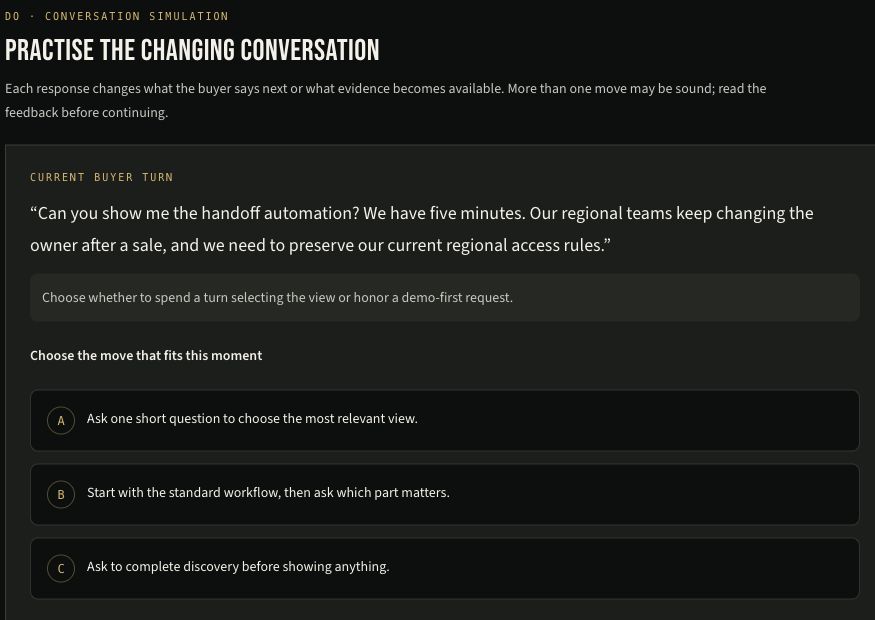
The Tech Sales practice workspace with a fictional buyer conversation and a choice of next moves.
Inside the Tech Sales practice workspace. A fictional teaching case; your choices change the conversation that follows.Try the free conversation sample
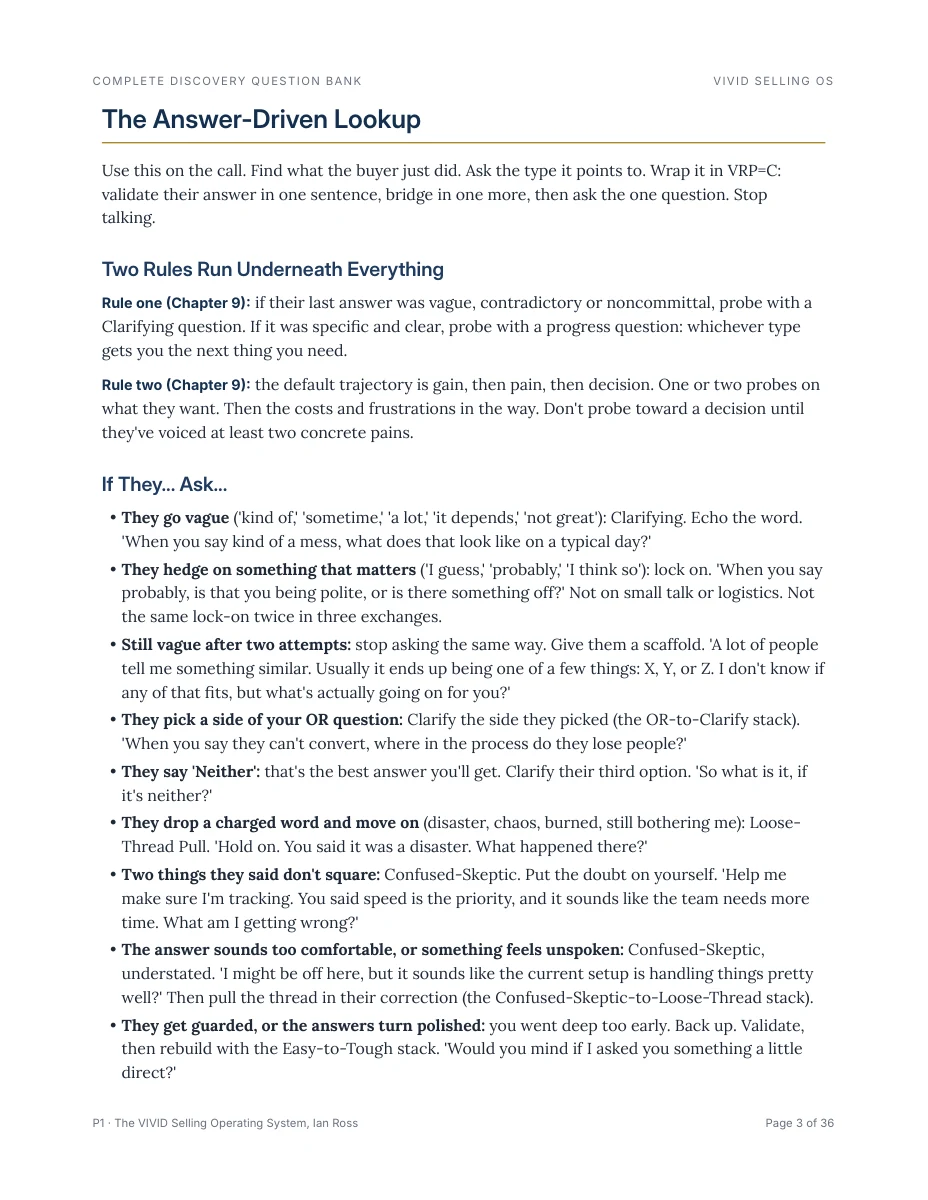
Actual page from the Complete Discovery Question Bank, showing buyer cues and follow-up questions.Read the actual page
A TOOL YOU CAN USE ON A CALLThe Answer-Driven Lookup

Find what the buyer just did. Choose a useful follow-up. This is page 3 of the 36-page Complete Discovery Question Bank, one of the PDF toolkits included with this course.

Explore the question bank

LESSONS & MATERIALS

Seven modules.
Twenty-nine lessons.

Study Tech Sales through written lessons, lesson PDFs, module workbooks, and course resources and tools, including the Diagnostic Demo Run Card. The curriculum below lists every lesson.

PRACTICE & ASSESSMENT

From feature request
to focused proof.

Begin with your own response, study an annotated software discovery conversation, then choose your next move and see how the buyer responds. Apply the skill to a fresh case and build a field kit for your next demo. Scenario assessments and practice labs help you apply the course material.

The guided practice uses prepared buyer replies and coaching feedback; the practice labs provide AI feedback.

VIVID Selling for Tech Sales

The complete
course curriculum.

Explore every module and lesson. The course applies the method to software discovery, demonstrations, multi-stakeholder decisions and the work that follows.

01The Diagnostic AE4 lessons
  1. Sarah vs. James — Two AEs, Same Product, Opposite Outcomes
  2. Commission Breath in Tech Sales — Feature-Dumping and Pipeline Worship
  3. The Product Expert Trap — When Deep Product Knowledge Becomes a Liability
  4. Discovery Is Not a Checklist — The Difference Between Qualifying and Diagnosing
02Earning the First Real Conversation4 lessons
  1. The Micro-VIVID for Cold Outreach — Emails That Earn Meetings Through Diagnosis
  2. The SDR-to-AE Handoff — What Gets Lost and How to Recover It
  3. Inbound Lead Response — When They Already Think They Know What They Want
  4. LinkedIn and Warm Introductions — Diagnostic Outreach at Scale
03The Diagnostic Demo4 lessons
  1. Why 42 Minutes of Perfect Proof Produces 'Let Me Think About It'
  2. The Five-Movement Demo Architecture
  3. Building the Peak — Using the Prospect's Own Data to Create the Decision Moment
  4. Fewer Features, Harder Landing — The Constraint That Creates Impact
04Multi-Stakeholder Deal Architecture4 lessons
  1. The Deal That Died in a Meeting You Weren't Invited To
  2. The Unified Deal Architecture — One Arc, Multiple Stakeholders
  3. Arming the Champion — Giving Them the Language to Sell When You're Not in the Room
  4. The Procurement Gap — Keeping Deals Alive Through Legal, Security, and Budget Approval
05Guided Persuasion for Tech Sales4 lessons
  1. GP in Discovery — Threading the Demo Before You Show It
  2. The Four Buyer Types in Tech Sales — Commander, Visionary, Analyst, Guardian
  3. When They've Already Seen Your Competitor's Demo
  4. GP in Proposals and Follow-Up — Carrying the Diagnostic Past the Demo
06When Deals Die — Dissolving Tech Sales Objections4 lessons
  1. Tracing Lost Tech Deals — Missed Layers, Stakeholders, and Other Causes
  2. The Top 6 Tech Sales Objections Dissolved
  3. Competitive Deals — When Features Are Equal and Understanding Wins
  4. Mapping Stakeholder Criteria in Tech Deals
07Watching Yourself Sell Software5 lessons
  1. Pipeline Forensics — Diagnosing Where Deals Actually Die
  2. Deal Velocity — Testing How Diagnostic Depth Affects Sales Cycles
  3. The 90-Day Installation Drill for Tech Sales AEs
  4. The Annotated Tech Sales Deal — From Discovery to a Buyer-Owned Next Step
  5. State Management for AEs — When Quota Pressure Contaminates Your Diagnostic

7 modules · 29 lessons, listed in full

Before you enroll

Before you enroll

What can I use today?

Written lessons, lesson PDFs, module workbooks, practice labs with AI feedback, scenario assessments and course resources. Video lessons are planned. Choose based on the materials available today.

Where should I start at my experience level?

If you are newer to selling, work through the lessons in order. If you already sell, choose a recurring conversation, study the relevant lesson, then practise and review the skill. The course supports deliberate practice; it does not promise a particular sales result.

Do I need to take a quiz first?

No. Choose a course based on the conversations you lead. For an optional starting point, try the short quiz.

How long do I have access?

Course and library purchases include 365 days of access. A renewal is a separate decision. Review the terms shown in checkout.

What if the course is not right for me?

Read the 365-day money-back guarantee and refund terms before purchasing. For help choosing or using the materials, contact support.

A relevant next step

Bring better
discovery to
your next demo.

Read the full worked example, try the limited sample, or review the Tech Sales course and its complete curriculum.