Skip to content
VIVIDSELLING
OS
Menu

The coursesAutomotive Sales

VIVID / Automotive Sales

Plan the test drive
around everyday use.

Understand how the buyer will use the vehicle, then let the relevant inventory, test drive and costs help them compare their options.

A buyer decision to explore

“I need something with more space.”

A useful next question “When does your current space become a problem?”

See how the conversation unfolds

7 modules · 29 lessons · 365 days of access

The book (in progress) explains the seven-layer method. This course applies it to Automotive Sales conversations; written lessons and practice are available now.

A broad preference can become a useful test

Find the
real use case.

“I need something with more space.” tells you where to begin. Ask when a lack of space creates a problem. The buyer’s own situation can guide what to check together during a walk-around or test drive.

Read the test-drive guide

BUYER

“I need something with more space.”

A USEFUL NEXT QUESTION

“When does your current space become a problem?”

BUYER REPLY

“On weekends, with two child seats and all the sports equipment.”

That gives the demonstration a job: check the real loading and seating situation together, then compare the options and costs clearly.

Fictional teaching example

TRY ANOTHER CONVERSATION / Automotive Sales

A different concern changes what you prepare.

Choose what you would ask next. Open each response to compare.

BUYER

When a buyer compares ownership cost and capability

A buyer compares two vehicles by estimated ownership cost and capability. No current specifications or cost details are in the conversation.

Fictional teaching case; names and details are invented.

WHAT WOULD YOU ASK NEXT?

What should you establish before comparing them?

Ask which capabilities matter and gather current official specifications and written ownership-cost assumptions.

Feedback on this response

This anchors the comparison in the buyer’s criteria and verified current information.

Compare the ownership-cost estimates first, then ask whether the less expensive option meets the buyer’s needs.

Feedback on this response

Cost can matter, but the estimates and required capabilities are both unknown. Clarify the criteria and inputs before ranking the options.
Try the full practice example

Try a free teaching sample

See what a
question can open.

Clarify the buyer’s boundaries, keep the terms together, and make the next comparison useful.

Fictional conversation · Two or three decisions · Editable call card

Try the Automotive Sales conversation

Choose the scope that fits

Choose the
showroom conversations you lead.

Choose Automotive Sales when you help buyers compare vehicles, test-drive options and make purchase decisions. The library includes all nine industry courses.

ONE INDUSTRY

VIVID selling
for automotive sales

$297

USD · one-time payment · 365 days · one learner

  • 7 modules and 29 lessons
  • Automotive Sales teaching and course curriculum
  • 18 PDF toolkits, plus lesson downloads and workbooks
Review Automotive Sales enrollment · $297

ALL 9 INDUSTRIES

The complete
course library

$497

USD · one-time payment · 365 days · one learner

  • All 9 industry courses
  • Explore other applications when useful
  • 18 PDF toolkits included
Review library enrollment · $497

You can enroll directly; the quiz is optional. The purchase flow shows the current access terms and checkout details. Written lessons and practice are available now; course videos are in preparation. 365-day money-back guarantee.

How the method shapes this conversation

Practical course work for showroom conversations

Help the buyer
test what matters.

The course develops needs conversations, relevant demonstrations, and tradeoffs and next steps through written lessons, worksheets, scenario assessments and practice labs.

01 / NEEDS CONVERSATIONS

Turn a broad preference into a specific use case.

Turn a broad preference into a specific use case.

02 / RELEVANT DEMONSTRATIONS

Let the buyer test what matters in the decision.

Let the buyer test what matters in their actual decision.

03 / TRADEOFFS AND NEXT STEPS

Clarify fit, cost and next steps without rushing.

Clarify fit, cost and process without rushing the choice.

Use the buyer’s criteria to guide the vehicle comparison, test drive and clear discussion of costs.

How the sample becomes course work

From the sample to your next conversation

PREPARE A VEHICLE CONSULTATION

Connect everyday use, total budget and trade-off questions to a relevant walk-around or test drive.

FOLLOW ONE ANSWER INTO A PLAN

A lower payment. What else changes?

One possible outcome from the free fictional example. The conversation card records what you heard and the next move it supports.

Read the worked conversation

In the paid course: Connect everyday use, total budget and trade-off questions to a relevant walk-around or test drive.

EXAMPLE CONVERSATION CARD Fictional teaching case
Buyer’s words
“Yes. Keep the term the same and show me the total amount I would pay.”
Next question
“Which written terms should we verify before comparing?”
What to prepare
Use actual price, term, rate, down payment and total of payments from current disclosures; leave unknowns blank.
After the conversation
Did you keep payment connected to total price and term?
Try the example and edit your own card

01 · STUDY THE METHOD

Let the buyer’s use case guide the vehicle comparison

The paid course includes “Matching Answers to Inventory — Through Their Words, Not Yours” in The Diagnostic Walk-Around, with a lesson PDF and module workbook. Start with the related free conversation below.

Read the free worked conversation

02 · TRY A REALISTIC CASE

Practise your next response

Start with your own response, study an annotated conversation, then practise a different fictional situation. The buyer’s response changes with your choice; feedback shows what to keep or repair.

Try the free decision practice

03 · TAKE A USEFUL PLAN AWAY

Prepare a vehicle consultation

Keep an editable conversation card in this browser after the free sample. The paid workspace adds an account-saved field kit. Check whether the vehicle evidence answered the customer’s stated needs and the numbers remained clear.

Build a free conversation card

These lessons and private workspaces are included with active course access. Practice uses authored buyer responses and feedback; written self-review does not generate a proficiency score. Video lessons are in preparation.

What is inside the course

Inside the Automotive Sales course

Lessons, practice
and working tools.

Review the written lessons, scenario assessments, practice labs, worksheets and tools in VIVID Selling for Automotive Sales before deciding whether the course fits your work.

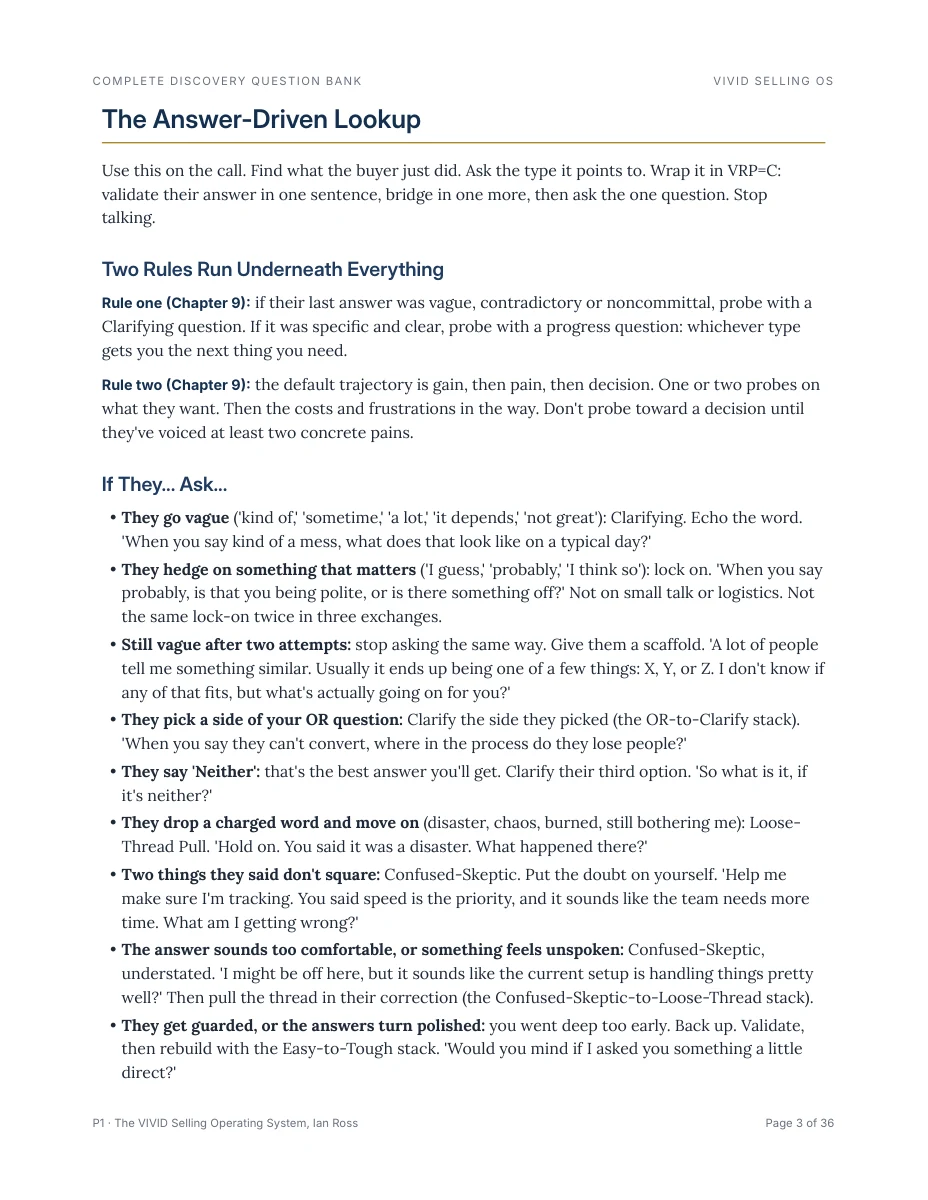
Actual page from the Complete Discovery Question Bank, showing buyer cues and follow-up questions.Read the actual page
A TOOL YOU CAN USE ON A CALLThe Answer-Driven Lookup

Find what the buyer just did. Choose a useful follow-up. This is page 3 of the 36-page Complete Discovery Question Bank, one of the PDF toolkits included with this course.

Explore the question bank

LESSONS & MATERIALS

Seven modules.
Twenty-nine lessons.

Study internet leads, phone-ups, service-drive conversations, diagnostic walk-arounds, vehicle matching, test drives, trade-ins, price discussions and post-sale self-review in written lessons, lesson PDFs, module workbooks and course tools. Every lesson is listed below.

PRACTICE & ASSESSMENT

Work through
industry situations.

Apply the material to buyer use cases, inventory choices, test drives and tradeoffs. Scenario assessments and practice labs support the work.

Practice labs provide AI feedback. Video lessons are planned.

VIVID Selling for Automotive Sales

The complete
course curriculum.

Explore all seven modules and twenty-nine lessons on showroom conversations, diagnostic walk-arounds, test drives, numbers, objections and ongoing practice.

01The Automotive Advisor4 lessons
  1. The Automotive Advisor: Posture, Inquiry and a Buyer-Owned Choice
  2. Commission Breath on the Showroom Floor — The Pounce, the Pitch, and the Pressure Ladder
  3. The Revealing Paradigm Within the Dealership’s Actual Process
  4. Linguistic Pull-Away: Honest Fit Questions and a Real Exit
02Earning the Conversation Across Channels4 lessons
  1. Internet Inquiries: Accurate Answers and an Optional Mini-Diagnostic
  2. Phone-Ups: Direct Answers and a Relevant Next Step
  3. Service-Drive Conversations: An Invitation the Customer Can Decline
  4. Be-Backs and Follow-Up: Continue the Agreed Question
03The Diagnostic Walk-Around4 lessons
  1. Seven Strategic Question Types in an Automotive Diagnostic
  2. Matching Answers to Inventory — Through Their Words, Not Yours
  3. Four Meaning Layers in a Vehicle Conversation
  4. “I’m Just Looking”: Orientation, Information or Space
04The Five VIVID Phases in a Vehicle Decision4 lessons
  1. Five VIVID Phases in a Vehicle Comparison
  2. The Test Drive: A Relevant Demonstration With a Real Mismatch Branch
  3. The Numbers Conversation: Comparable Terms and an Honest Handoff
  4. Trade-In Conversations: Value, Payoff and Optional Personal Meaning
05Guided Persuasion on the Floor and in F&I4 lessons
  1. GP on the Showroom Floor — When They Can See and Touch the Product
  2. F&I: Actual Loan Terms and Optional Product Decisions
  3. Four Buyer Types: Canonical Drivers and Checked Delivery Preferences
  4. When the Buyer Has Compared Other Dealerships
06Understanding Automotive Concerns and Constraints4 lessons
  1. Understanding a Walk-Out Without Presuming a Leaked Phase
  2. Responding to Six Common Automotive Concerns
  3. Price Requests: Clarification, Negotiation and Real Constraints
  4. Timing Facts and Buyer Momentum Without Manufactured Urgency
07The Observer in Automotive Conversations5 lessons
  1. The Observer: Review Your Actual Automotive Conversation
  2. CSI Scores as Diagnostic Feedback — What Customer Surveys Actually Tell You
  3. State Management on the Lot — Energy, Weather, Rotation, and the Saturday Grind
  4. The 90-Day Installation Drill for Automotive Sales
  5. The Annotated Vehicle Conversation — Phases, Evidence and a Decision to Pause

7 modules · 29 lessons, listed in full

Before you enroll

Before you enroll

What can I use today?

Written lessons, lesson PDFs, module workbooks, practice labs with AI feedback, scenario assessments and course resources. Video lessons are planned. Choose based on the materials available today.

Where should I start at my experience level?

If you are newer to selling, work through the lessons in order. If you already sell, choose a recurring conversation, study the relevant lesson, then practise and review the skill. The course supports deliberate practice; it does not promise a particular sales result.

Do I need to take a quiz first?

No. Choose a course based on the conversations you lead. For an optional starting point, try the short quiz.

How long do I have access?

Course and library purchases include 365 days of access. A renewal is a separate decision. Review the terms shown in checkout.

What if the course is not right for me?

Read the 365-day money-back guarantee and refund terms before purchasing. For help choosing or using the materials, contact support.

A relevant next step

Prepare a vehicle consultation.

Read the test-drive guide or explore the complete Automotive Sales curriculum before choosing.