
Skip to content
VIVIDSELLING
OS
Menu

The coursesInsurance Producers

VIVID / Insurance Producers

Explain coverage
against the client’s needs.

Understand the exposure a client cares about, then explain relevant coverage, limits and costs clearly and accurately.

A buyer decision to explore

“I just want the cheapest policy.”

A useful next question “What do you want to be certain is covered, even if we keep the cost down?”

See how the conversation unfolds

7 modules · 30 lessons · 365 days of access

The book (in progress) explains the seven-layer method. This course applies it to Insurance Producers conversations; written lessons and practice are available now.

A quote request has a reason behind it

Make the coverage
conversation useful.

“I just want the cheapest policy.” tells you where to begin. Explore what the client wants to protect and what they already have before comparing policies. Keep needs, coverage terms and costs accurate.

Read the insurance needs-analysis guide

CLIENT

“I just want the cheapest policy.”

A USEFUL NEXT QUESTION

“What do you want to be certain is covered, even if we keep the cost down?”

CLIENT REPLY

“If I couldn't work, I couldn't keep the mortgage paid.”

That answer gives the comparison a purpose. Explore the situation, then explain relevant benefits, exclusions and costs accurately.

Fictional teaching example

TRY ANOTHER CONVERSATION / Insurance Producers

A different concern changes what you prepare.

Choose what you would ask next. Open each response to compare.

CLIENT

When a person asks whether a dependent is covered

A person with an individual policy asks whether a new dependent is covered. No policy or endorsement has been reviewed.

Fictional teaching case; names and details are invented.

WHAT WOULD YOU ASK NEXT?

What is the responsible next step?

Ask to review the current policy and relevant endorsement with the person, then identify what remains to confirm with the insurer.

Feedback on this response

This anchors the discussion in actual terms and routes unresolved coverage questions to the source responsible for them.

Begin by asking what protection the person wants for the dependent, then discuss whether the existing amount seems suitable.

Feedback on this response

A needs discussion may be useful later. The immediate question is about what the current policy says; beginning with amounts leaves that question unanswered.
Try the full practice example

Try a free teaching sample

See what a
question can open.

Find out what the person wants to understand before discussing another option. Practise a useful next step when the policy details are still unknown.

Fictional conversation · Two or three decisions · Editable call card

Try the Insurance Producers conversation

Choose the scope that fits

Choose the
client conversations you lead.

Choose Insurance Producers when you discuss protection needs, recommendations and policy follow-through. The library includes all nine industry courses.

ONE INDUSTRY

VIVID selling
for insurance producers

$297

USD · one-time payment · 365 days · one learner

  • 7 modules and 30 lessons
  • Insurance Producers teaching and course curriculum
  • 18 PDF toolkits, plus lesson downloads and workbooks
Review Insurance Producers enrollment · $297

ALL 9 INDUSTRIES

The complete
course library

$497

USD · one-time payment · 365 days · one learner

  • All 9 industry courses
  • Explore other applications when useful
  • 18 PDF toolkits included
Review library enrollment · $497

You can enroll directly; the quiz is optional. The purchase flow shows the current access terms and checkout details. Written lessons and practice are available now; course videos are in preparation. 365-day money-back guarantee.

How the method shapes this conversation

Practical course work for insurance conversations

Connect the
need to the coverage.

The course develops risk conversations, clear recommendations, and renewal and retention through written lessons, worksheets, scenario assessments and practice labs.

01 / RISK CONVERSATIONS

Explore the risk behind the quote.

Explore the situations behind a request for a quote.

02 / CLEAR RECOMMENDATIONS

Connect needs to clear recommendations.

Connect coverage details to stated needs and constraints.

03 / RENEWAL AND RETENTION

Review changes at renewal.

Review what changed before assuming the existing policy still fits.

Explain relevant benefits, exclusions and costs; do not imply a policy covers more than its terms.

How the sample becomes course work

From the sample to your next conversation

PREPARE A PROTECTION CONVERSATION

Use the customer’s priorities to explain what each option protects, what it costs and the trade-offs to discuss.

FOLLOW ONE ANSWER INTO A PLAN

“I already have coverage.” Where do you begin?

One possible outcome from the free fictional example. The conversation card records what you heard and the next move it supports.

Read the worked conversation

In the paid course: Use the customer’s priorities to explain what each option protects, what it costs and the trade-offs to discuss.

EXAMPLE CONVERSATION CARD Fictional teaching case
Buyer’s words
“Whether anything can continue, what steps are required, and when I would need to decide.”
Next question
“Which terms should we check and who can confirm them?”
What to prepare
List continuation, portability, required steps and deadlines as questions for the current plan administrator; do not fill answers from memory.
After the conversation
Did you distinguish a question about coverage from evidence of a coverage gap?
Try the example and edit your own card

01 · STUDY THE METHOD

Turn a needs analysis into a clear protection story

The paid course includes “Five Phases in a Term Life Needs Analysis” in From First Call to Policy Delivery, with a lesson PDF and module workbook. Start with the related free conversation below.

Read the free worked conversation

02 · TRY A REALISTIC CASE

Practise your next response

Start with your own response, study an annotated conversation, then practise a different fictional situation. The buyer’s response changes with your choice; feedback shows what to keep or repair.

Try the free decision practice

03 · TAKE A USEFUL PLAN AWAY

Prepare a protection conversation

Keep an editable conversation card in this browser after the free sample. The paid workspace adds an account-saved field kit. Identify what the customer understood, what remains unverified and whether the proposed next step fits.

Build a free conversation card

These lessons and private workspaces are included with active course access. Practice uses authored buyer responses and feedback; written self-review does not generate a proficiency score. Video lessons are in preparation.

What is inside the course

Inside the Insurance Producers course

Lessons, practice
and working tools.

Review the written lessons, scenario assessments, practice labs, worksheets and tools in VIVID Selling for Insurance Producers before deciding whether the course fits your work.

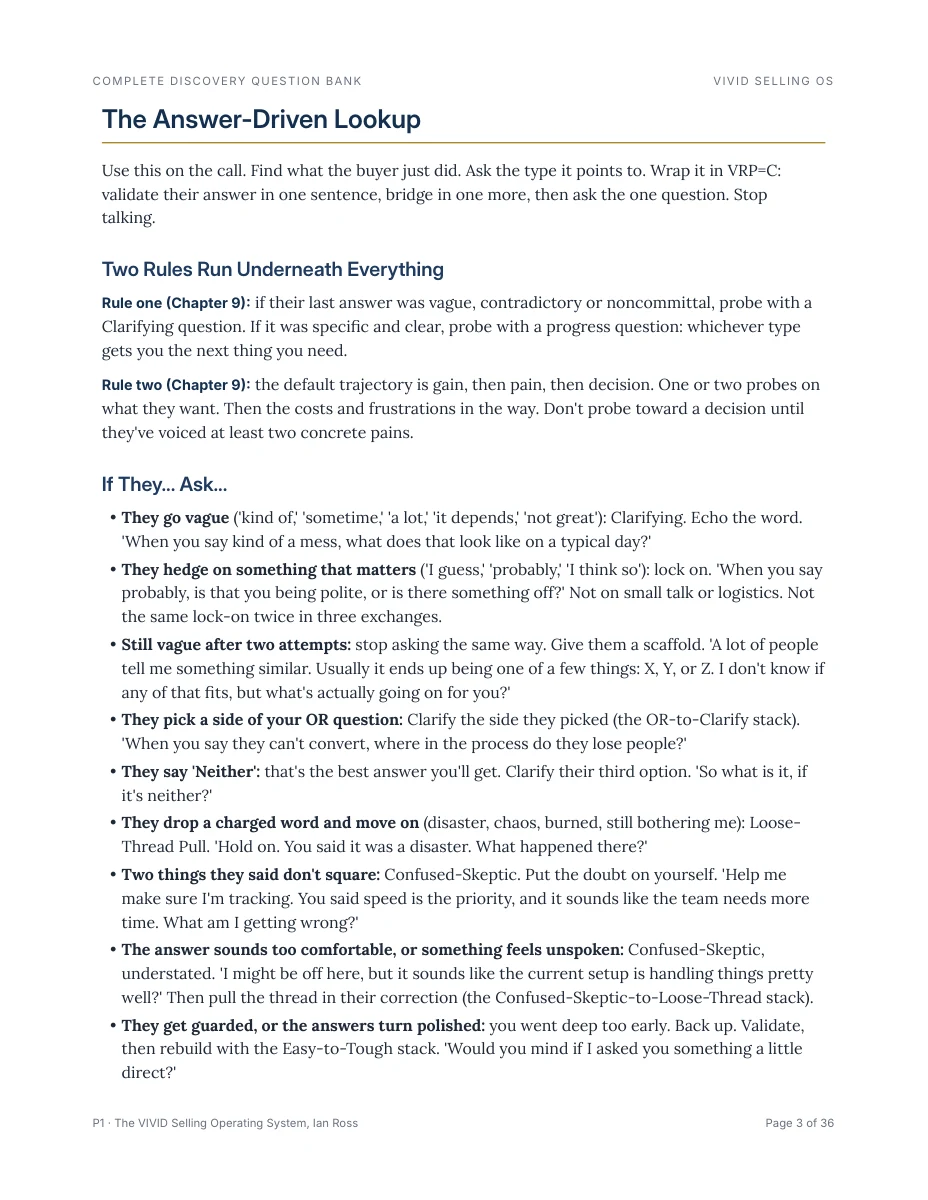
Actual page from the Complete Discovery Question Bank, showing buyer cues and follow-up questions.Read the actual page
A TOOL YOU CAN USE ON A CALLThe Answer-Driven Lookup

Find what the buyer just did. Choose a useful follow-up. This is page 3 of the 36-page Complete Discovery Question Bank, one of the PDF toolkits included with this course.

Explore the question bank

LESSONS & MATERIALS

Seven modules.
Thirty lessons.

Study referral and life-event conversations, needs-analysis questions, five-phase call structure, underwriting follow-through, risk explanation, objections and post-appointment review in written lessons, lesson PDFs, module workbooks and course tools.

PRACTICE & ASSESSMENT

Work through
industry situations.

Apply the lessons to client needs, coverage comparisons and follow-up situations. Scenario assessments and practice labs extend the written course work.

Practice labs provide AI feedback. Video lessons are planned.

VIVID Selling for Insurance Producers

The complete
course curriculum.

Explore all seven modules and thirty lessons, from first contact and needs analysis through policy delivery, risk explanation, objections and ongoing practice.

01The Protection Architect4 lessons
  1. Diagnostic Posture in Insurance Conversations
  2. From Household Story to Verified Decision
  3. The Revealing Paradigm with a Skeptical Prospect
  4. Building the Protection Architect Identity
02Breaking the Insurance Pattern4 lessons
  1. The First 15 Seconds — When They Already Expect a Pitch
  2. Referral Conversations: The Accepted Warm Introduction
  3. Life-Event Cold Outreach — New Home, New Baby, New Business
  4. The Referral Ecosystem: Roles, Introductions and Follow-Through
03The Pain-to-Gain Bridge4 lessons
  1. Diagnostic Inquiry Before an Insurance Recommendation
  2. Adapting Pace to the Customer’s Expressed Preference
  3. The Seven Question Types Applied to Insurance Discovery
  4. The Pain-to-Gain Bridge in Practice
04From First Call to Policy Delivery5 lessons
  1. Five Phases from Insurance Review to Decision
  2. Five Phases in a Term Life Needs Analysis
  3. Where the Bridge Lives Inside the Five Phases
  4. Managing the Underwriting Gap
  5. VIVID Architecture Across Insurance Lines
05Making the Invisible Visible4 lessons
  1. The Art of Making Risk Real Without Making It Terrifying
  2. GP Modes in Action — Reading the Window in an Insurance Practice
  3. Illustrative Math in an Insurance Needs Analysis
  4. Commercial Insurance Discovery Without Assumed Gaps
06Understanding Concerns and Supporting the Decision4 lessons
  1. Understanding Insurance Objections Before Responding
  2. Clarifying Insurance Concerns Without Assuming a Hidden Objection
  3. Trust, Skepticism, and 'Insurance Is a Scam'
  4. Timing Facts Without Manufactured Urgency
07Watching Yourself Sell Protection5 lessons
  1. The Observer: Correcting Your Own Next Move
  2. Practical Workload and Capacity Checks
  3. Post-Appointment Review — Observable Turns and Evidence
  4. Pipeline Architecture and the 90-Day Installation
  5. The Annotated Needs Analysis: Phases, Bridge and Customer Choice

7 modules · 30 lessons, listed in full

Before you enroll

Before you enroll

What can I use today?

Written lessons, lesson PDFs, module workbooks, practice labs with AI feedback, scenario assessments and course resources. Video lessons are planned. Choose based on the materials available today.

Where should I start at my experience level?

If you are newer to selling, work through the lessons in order. If you already sell, choose a recurring conversation, study the relevant lesson, then practise and review the skill. The course supports deliberate practice; it does not promise a particular sales result.

Do I need to take a quiz first?

No. Choose a course based on the conversations you lead. For an optional starting point, try the short quiz.

How long do I have access?

Course and library purchases include 365 days of access. A renewal is a separate decision. Review the terms shown in checkout.

What if the course is not right for me?

Read the 365-day money-back guarantee and refund terms before purchasing. For help choosing or using the materials, contact support.

A relevant next step

Prepare a protection conversation.

Read the needs-analysis guide or inspect all seven modules and thirty lessons before choosing.