
Skip to content
VIVIDSELLING
OS
Menu

The coursesCoaches

VIVID / Coaches

Show what coaching
would involve.

Understand the pattern behind ‘I know what to do.’ Help a prospect see what working together would involve—and decide whether it fits.

A buyer decision to explore

“I know what I should be doing. I just don't follow through.”

A useful next question “When does following through become difficult?”

See how the conversation unfolds

7 modules · 29 lessons · 365 days of access

The book (in progress) explains the seven-layer method. This course applies it to Coaches conversations; written lessons and practice are available now.

Understand before you offer a plan

Let discovery lead
to a better
enrollment decision.

“I know what I should be doing. I just don't follow through.” tells you where to begin. Ask when follow-through becomes difficult and what the prospect has already tried. Let their account shape what you explore next and what you can responsibly say about the work.

Read the complete guide to coaching on discovery calls

PROSPECT

“I know what I should be doing. I just don't follow through.”

A USEFUL NEXT QUESTION

“When does following through become difficult?”

Fictional teaching example

TRY ANOTHER CONVERSATION / Coaches

A different concern changes what you prepare.

Choose what you would ask next. Open each response to compare.

PROSPECT

When a prospect keeps restarting a proposal

A new prospect says they rewrite proposals repeatedly because “a rough draft makes me look careless.” They have tried deadlines, but restart whenever a colleague could see the work.

Fictional teaching case; names and details are invented.

WHAT WOULD YOU ASK NEXT?

Which next question best investigates the mechanism behind the repeated editing?

“What would a colleague need to see in a working draft for you to feel it represents you fairly?”

Feedback on this response

The prospect’s phrase carries Identity meaning. This asks them to define their standard so it can be compared with the purpose of a working draft.

“Would a daily check-in or a shorter deadline help you send it sooner?”

Feedback on this response

Both options could support action, but both assume missing accountability is the mechanism. The prospect has already said deadlines did not change the decision.
Try the full practice example

Try a free teaching sample

Notice what each
question reveals.

Choose your next move, see how the conversation changes, then keep an editable conversation card. Try a different situation to check what you learned.

Fictional conversation · Two or three decisions · Editable call card

Try the Coaches conversation

Choose the scope that fits

Start with the
conversations you lead.

Choose Coaches when enrollment and fit conversations are part of your work. Choose the library when you will use other industry applications too.

ONE INDUSTRY

VIVID selling
for coaches

$297

USD · one-time payment · 365 days · one learner

  • 7 modules and 29 lessons
  • Coaches teaching and course curriculum
  • 18 PDF toolkits, plus lesson downloads and workbooks
Review Coaches enrollment · $297

ALL 9 INDUSTRIES

The complete
course library

$497

USD · one-time payment · 365 days · one learner

  • All 9 industry courses
  • Explore other applications when useful
  • 18 PDF toolkits included
Review library enrollment · $497

Enroll directly; the quiz is optional. The purchase flow shows the current access terms and checkout details. Written lessons and practice are available now; course videos are in preparation. 365-day money-back guarantee.

How the method shapes this conversation

Five phases for an enrollment conversation

Help the prospect
judge the fit.

Use the Five Phases as conversation jobs: understand the future the prospect wants, map what is happening now, acknowledge concerns and check your understanding, consider impact using their own inputs, and make scope and choice clear. Return to validation whenever a concern needs attention.

01 / VISION

Understand the future they want.

Ask what would be different if the issue were handled well. Keep the prospect's description and priorities in their own words.

02 / IDENTIFY

Map the present situation.

Explore the current pattern, prior attempts and constraints. Use specific questions before forming a view of what is getting in the way.

03 / VALIDATE

Acknowledge the concern and check your understanding.

Reflect the concern or experience the prospect has described and ask whether you understood it. Invite a correction before responding. Acknowledging their experience does not require agreeing with every interpretation.

04 / IMPACT

Consider what the pattern affects.

Use the prospect's real examples and numbers if they have them. Ask what the situation changes for them without supplying costs or urgency they have not established.

05 / DECISION

Make the work and choice explicit.

Explain the service scope, commitments, terms and limits. Leave room for yes, no, not now, a referral or a request for more information.

A bounded demonstration can show how you work after discovery; it should not turn the enrollment call into a full coaching session.

How the sample becomes course work

From the sample to your next conversation

PREPARE AN ENROLLMENT CONVERSATION

Help a prospect recognize their own pattern, experience a relevant sample of the work and decide whether the program fits.

FOLLOW ONE ANSWER INTO A PLAN

They tried accountability. What needs to change?

One possible outcome from the free fictional example. The conversation card records what you heard and the next move it supports.

Read the worked conversation

In the paid course: Help a prospect recognize their own pattern, experience a relevant sample of the work and decide whether the program fits.

EXAMPLE CONVERSATION CARD Fictional teaching case
Buyer’s words
“I imagined them waiting and doubting me.”
Next question
“Would you like to take that one message and compare your actual promise with what you felt you had to do?”
What to prepare
Demonstrate that single distinction. Then explain how the fictional program uses weekly pattern review and between-session experiments; separate the sample from the full commitment.
After the conversation
Did the prospect name the belief, or did you supply a diagnosis for them?
Try the example and edit your own card

01 · STUDY THE METHOD

Give each part of the enrollment call a purpose

The paid course includes “The Five Coaching Application Jobs — A Responsive Enrollment Structure” in The Five Phases — Enrollment Call Architecture, with a lesson PDF and module workbook. Start with the related free conversation below.

Read the free worked conversation

02 · TRY A REALISTIC CASE

Practise your next response

Start with your own response, study an annotated conversation, then practise a different fictional situation. The buyer’s response changes with your choice; feedback shows what to keep or repair.

Try the free decision practice

03 · TAKE A USEFUL PLAN AWAY

Prepare an enrollment conversation

Keep an editable conversation card in this browser after the free sample. The paid workspace adds an account-saved field kit. Check whether your questions revealed a useful pattern and whether the proposed work actually fits.

Build a free conversation card

These lessons and private workspaces are included with active course access. Practice uses authored buyer responses and feedback; written self-review does not generate a proficiency score. Video lessons are in preparation.

What is inside the course

Inside the Coaches course

Lessons, practice
and working tools.

Review the written lessons, full curriculum, practice labs, scenario assessments and course resources before deciding whether this course fits your enrollment conversations.

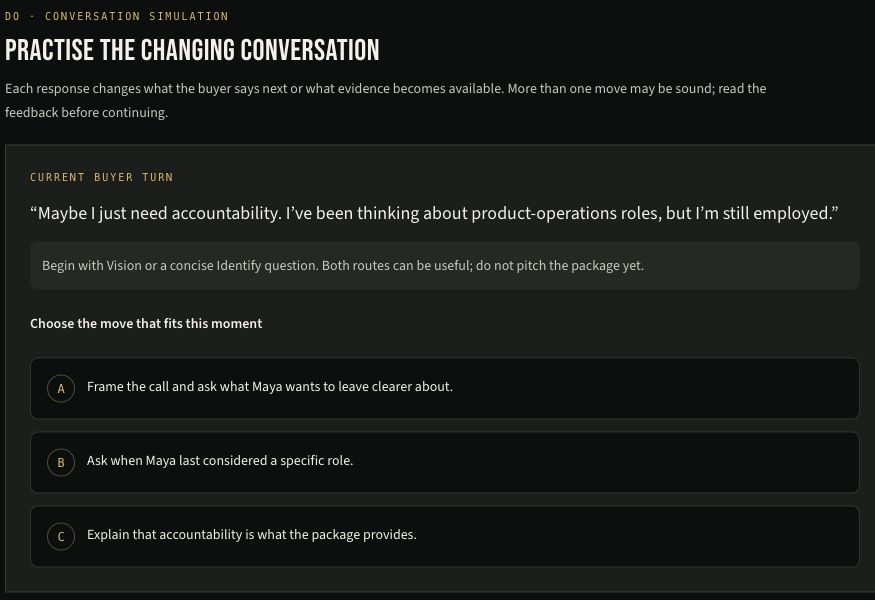
The Coaches practice workspace: a fictional prospect considering career support, with three possible next moves.
Inside the Coaches practice workspace. A fictional teaching case; your choices change the conversation that follows.Try the free conversation sample
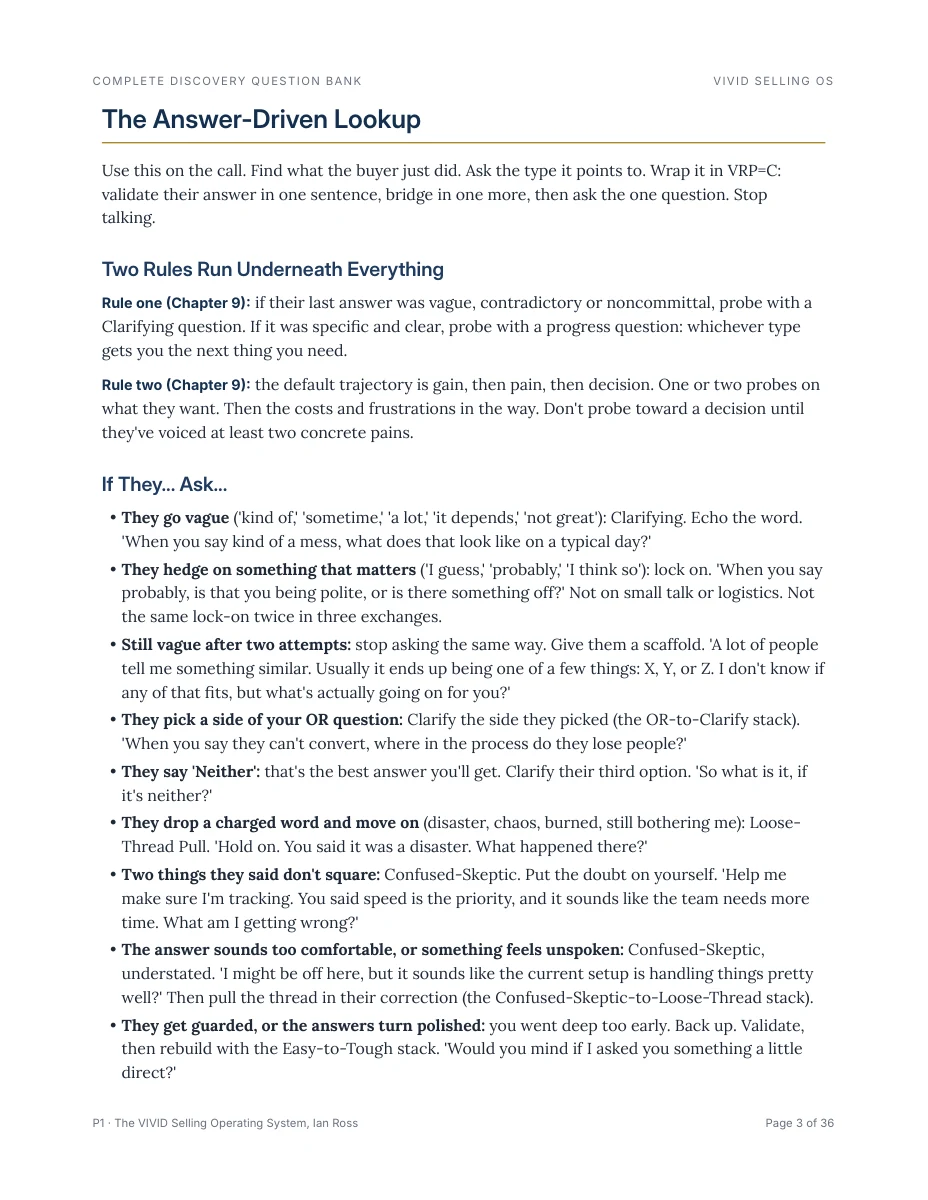
Actual page from the Complete Discovery Question Bank, showing buyer cues and follow-up questions.Read the actual page
A TOOL YOU CAN USE ON A CALLThe Answer-Driven Lookup

Find what the buyer just did. Choose a useful follow-up. This is page 3 of the 36-page Complete Discovery Question Bank, one of the PDF toolkits included with this course.

Explore the question bank

LESSONS & MATERIALS

Seven modules.
Twenty-nine lessons.

Study VIVID Selling for Coaches through written lessons, lesson PDFs, module workbooks, course resources and VIVID tools. The full lesson list below lets you inspect the course before choosing.

PRACTICE & ASSESSMENT

Rehearse an enrollment call.

Begin with your own response, study an annotated coaching conversation, then choose your next move and see how the prospect responds. Apply the skill to a fresh case and build a field kit for your next enrollment call. Practice labs and scenario assessments extend the work.

The guided practice uses prepared prospect replies and coaching feedback; the practice labs provide AI feedback.

VIVID Selling for Coaches

The complete
course curriculum.

Explore every module and lesson. The Coaches course applies the VIVID method to coaching discovery, fit, concerns, bounded demonstrations, scope and clear enrollment decisions.

01The Coach-As-Product Problem4 lessons
  1. Coaches and Selling — Examine the Tension Between Help and Enrollment
  2. Commission Breath on the Enrollment Call
  3. The Revealing Paradigm When YOU Are the Product
  4. The Coaching Pricing Paradox — Care, Scope, and Sustainable Fees
02The Five Phases — Enrollment Call Architecture4 lessons
  1. The Five Coaching Application Jobs — A Responsive Enrollment Structure
  2. The Situation Map — Clarify Before You Interpret
  3. Silence, Pacing, and the Four-Second Pause
  4. The Decision Frame — A Summary and an Invitation, Not a Close
03The Loop Architecture4 lessons
  1. Useful Answers and Further Questions — A Bounded Coaching Sample
  2. The Four Layers Applied to Coaching Enrollment
  3. The Four-Move Sequence — Explain, Test, and Hand the Result Back
  4. Ethical Framing — Accuracy, Scope, and Buyer Choice
04Coaching Objections — Diagnose the Concern Before Responding4 lessons
  1. The Twelve Coaching Objections — Diagnose Before You Respond
  2. Understanding 'I Can't Afford It' — Budget, Fit, and Real Limits
  3. Understanding 'I Had a Bad Experience With a Coach' — Check What Happened
  4. Understanding 'I Need to Think About It' — Clarify or Respect Time
05The Offer Is a Design Problem — Architecture, Pricing, and Structure4 lessons
  1. Offer Architecture — Design From the Result Backward
  2. Container and Outcome Pricing — Connect Scope to the Desired Result
  3. Three Structures, Three Use Cases — Intensive, Package, Retainer
  4. Group Program Enrollment — Open vs. Rolling and the Peer Group Case
06The Enrollment Window — Three Moves From Discovery Call to Decision4 lessons
  1. Enrollment Follow-Up — Agree the Timing and Purpose
  2. The Same-Day Reflection Note
  3. The Honest Follow-Up Close — Direct and Permission-Based
  4. Long-Range Follow-Up — Relevance Over Persistence
07The Referral Engine, Pipeline Architecture, and the 90-Day Installation5 lessons
  1. The Referral Process — Build on Confirmed Value and Permission
  2. The Referral Framing Conversation — Giving Clients the Story, the Language, and the Profile
  3. Enrollment Pipeline Architecture — Plan for Variable Demand
  4. The 90-Day Installation Drill and State Management
  5. The Referred Prospect Landing Experience — Verify Context and Earn Permission

7 modules · 29 lessons, listed in full

Before you enroll

Before you enroll

What can I use today?

Written lessons, lesson PDFs, module workbooks, practice labs with AI feedback, scenario assessments and course resources. Video lessons are planned. Choose based on the materials available today.

Where should I start at my experience level?

If you are newer to selling, work through the lessons in order. If you already sell, choose a recurring conversation, study the relevant lesson, then practise and review the skill. The course supports deliberate practice; it does not promise a particular sales result.

Do I need to take a quiz first?

No. Choose a course based on the conversations you lead. For an optional starting point, try the short quiz.

How long do I have access?

Course and library purchases include 365 days of access. A renewal is a separate decision. Review the terms shown in checkout.

What if the course is not right for me?

Read the 365-day money-back guarantee and refund terms before purchasing. For help choosing or using the materials, contact support.

A relevant next step

Prepare an enrollment conversation.

Read the guide, try the limited fictional sample, or review all seven modules and twenty-nine lessons before you decide.